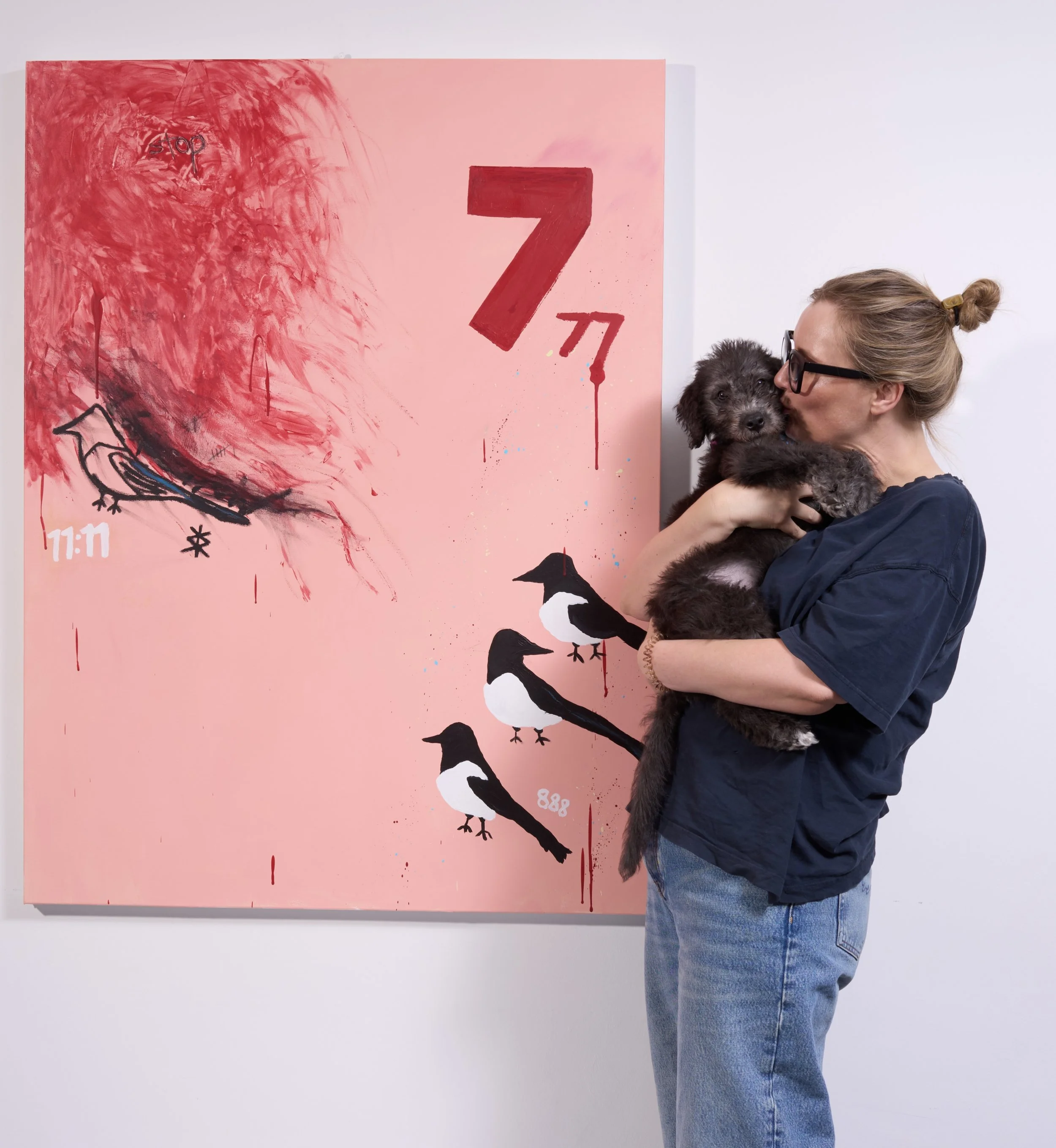
Kate Rugg is a British contemporary artist.
Working primarily in acrylic, oil pastel and graphite, her paintings explore the rituals, superstitions and private systems people construct in response to uncertainty.
Her ongoing body of work, Systems of Protection, draws on personal experience, inherited folklore and familiar cultural symbols to examine the point at which repetition, reassurance and belief become invested with consequence.
Magpies, numbers, repeated phrases and other seemingly ordinary motifs recur throughout the work, forming a visual language concerned with control, protection and the human impulse to find meaning in chance.
Kate came to painting following a career spanning fashion, design and creative direction. This background informs an instinctive approach to composition, colour and image-making, while her practice has developed independently outside traditional art-school training.
She lives and works in Surrey, UK.
Artists statement
Systems of Protection explores the structures we construct to protect ourselves from uncertainty: rituals, superstitions, repeated phrases, numbers and private rules that offer an illusion of control over things we cannot control.
Drawing on personal experience alongside inherited folklore and familiar cultural symbols, the work considers the point at which an arbitrary action or object becomes charged with consequence. A solitary magpie becomes an omen; a particular number feels safe; a repeated phrase becomes reassurance. These systems may appear irrational from the outside, yet from within they can feel entirely logical and necessary.
Working primarily with acrylic, oil pastel and graphite, I use layering, repetition, erasure and partially obscured marks to echo the processes behind the rituals themselves. Images and text are constructed, disrupted and overwritten, allowing earlier decisions to remain visible beneath the surface.
Increasingly, I am interested in the boundary between private and socially accepted systems of protection: between superstition, ritual, reassurance and belief. Rather than attempting to resolve these distinctions, the work asks why we create structures of meaning around uncertainty - and what happens when the systems we rely upon fail to make us feel safe.